STEM Gamification and Design Thinking: Engaging Students in Innovation
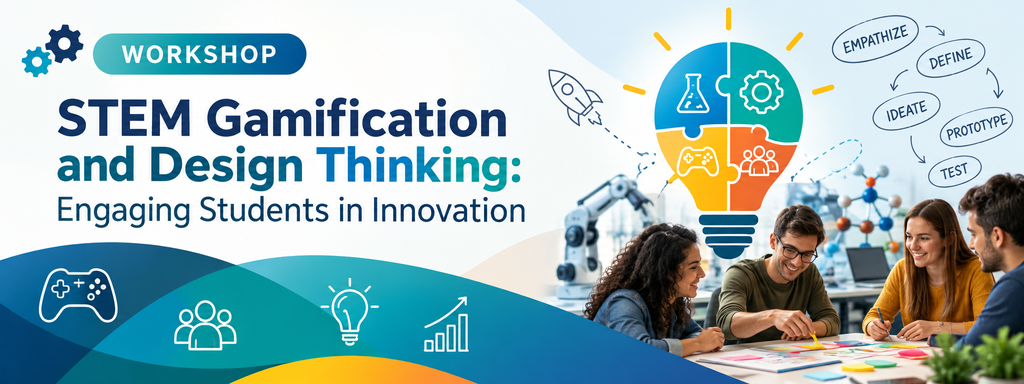
This interactive workshop explores how gamification and design thinking can enhance student engagement, creativity, and innovation in STEM education. Participants will be introduced to game-based learning principles, user-centred design methodologies, and collaborative problem-solving techniques through practical exercises and real-world STEM challenges.
The workshop combines short introductory presentations with hands-on, team-based activities, guiding participants through problem identification, idea generation, and the development of innovative solutions. Particular emphasis will be placed on experiential learning, creative thinking, and the application of gamification techniques to support STEM innovation and entrepreneurship. The activity is organised within the framework of the STEM2SCALE project, contributing to WP3 student training and the pilot implementation of innovative educational methodologies.
- Type: Interactive workshop
- Duration: 2 hours (proposed)
- Date: 02.06.2027, 16:00 – 18:00
- Target audience: STEM students, early-career researchers, educators and participants interested in innovation and entrepreneurship
- Methodology: Short presentations, interactive exercises, collaborative design thinking and gamified problem-solving
- Expected outcomes: Practical understanding of gamification and design thinking, improved creative problem-solving skills, and initial innovative STEM concepts developed through teamwork.
WORKSHOP Organizers

Ass. Prof. Marios Antonakakis, Hellenic Mediterranean University (HMU); e-mail: mantonakakis@hmu.gr
Dr.-Ing. Marios Antonakakis is an Assistant Professor at the Hellenic Mediterranean University, specializing in Artificial Intelligence and data-driven modeling of complex environmental and energy systems.

Prof. Antonios Konstantaras , Hellenic Mediterranean University (HMU); e-mail: akonstantaras@hmu.gr
Dr. Antonios Konstantaras is a professor at the Hellenic Mediterranean University, specializing in Parallel Processing, Heterogeneous Parallel Programming, Deep Learning, Electromagnetic Ontology, Seismic Ontology, Programming and programmable devices in K6-K12 primary education..

Ass. Prof. Nikolaos Spanoudakis, Hellenic Mediterranean University (HMU); e-mail: nspan@hmu.gr
Dr. Nikolaos Spanoudakis is an Assistant Professor in the field of: “Web Programming and Mobile Device Applications”. Informatics & Automation Sector.